

The Gulf Centre for Human rights (GCHR), with the support of 27 partners held the online event, the Alternative Human Rights Expo 4, on 04 December 2025, with a focus on women human rights defenders. You can hear from the family and colleagues of women who have been imprisoned in Iran, Egypt, Saudi Arabia and Tunisia, and from women journalists, writers, artists, musicians and poets.
We highlighted the work and creativity of women from Egypt, Iran, Kuwait, Palestine, Saudi Arabia, Sudan, Syria and Tunisia, and honoured the memories of Palestinian women journalists, artists and poets who have been killed.
You can find the video online now on YouTube, made with our partner Muwatin, and the full event video here.
The event was held during the 16 Days of Activism Against Gender-based Violence, which started on 25 November 2025, the International Day for the Elimination of Violence against Women, and ran until 10 December, International Human Rights Day.
We also worked with the WHRD International Coalition (WHRD-IC) to support the “Spreading the Echo” campaign that occurs as part of the #16Days campaign, including with partners FEMENA and the WHRD-MENA Coalition. The campaign features Iranian, Saudi and Egyptian women highlighted during the Alternative Human Rights Expo.
You can find the Programme here . Thanks to the 27 partners who joined us to help create and promote the event.
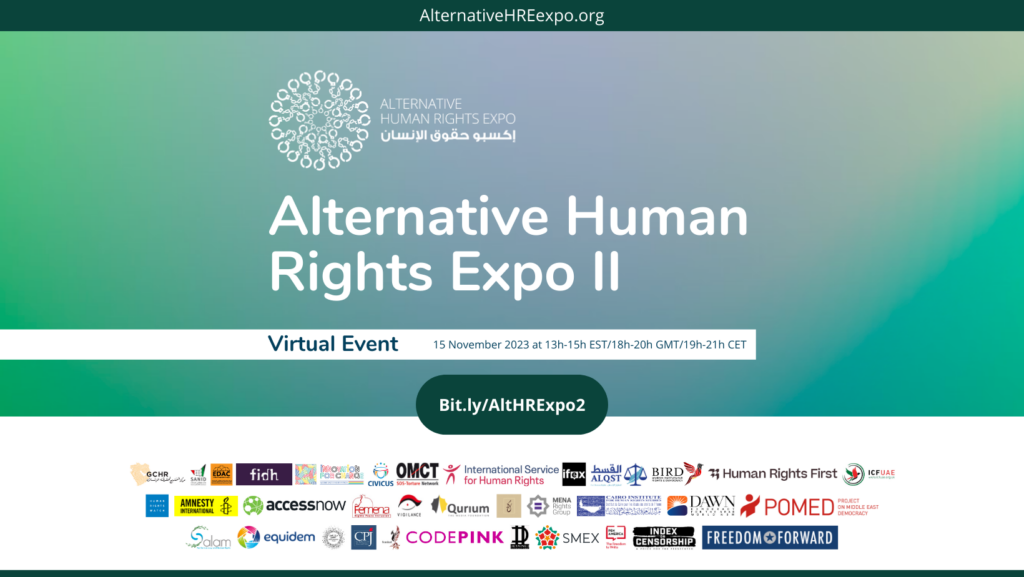
For more information on the previous 3 Alternative Human Rights Expos, keep reading below!
Watch the third Alternative Human Rights Expo
 As we approach International Human Rights Defenders Day on 09 December 2024, the Gulf Centre for Human Rights (GCHR) asks supporters to watch the recording of the third Alternative Human Rights Expo, held online on 27 November 2024, with the support of over two dozen partners, and amplify our calls to release human rights defenders (HRDs) persecuted in the Middle East and North Africa (MENA) region by showcasing the work of detained HRDs, WHRDs and activists, as well as artists, poets, writers and musicians from the MENA region with a focus on human rights.
There was a generous amount of solidarity between participants, some of whom had been imprisoned or persecuted, or have family members in prison in Bahrain, Egypt, Iran, Saudi Arabia and the United Arab Emirates (UAE), and with the people of Palestine and Lebanon.
The event opened with music by multi-generational Arab women’s drum and vocal ensemble Tabiba, made up of world music artists based in Canada who are from Palestine, Syria, Egypt and Iraq. Tabiba, which mixes the colours of their voices, traditions and inspirations to make music medicine, performed “Marhaba” (“Hello”).
“Today’s event is not an entertainment event; it is rather of a cathartic and awareness-raising nature; we are aiming to show the reality of the human rights defenders we work with,” said GCHR’s Executive Director Khalid Ibrahim, who co-hosted the event.
Co-host Marwa Fatafta, Access Now’s MENA Policy and Advocacy Director, added, “This event is not an entertainment show but a sober reminder of the gruesome reality which human rights defenders, artists, journalists, and dissidents in the MENA region are actively working to change. For this purpose, I was tasked with laying the landscape by giving a regional overview – and I cannot but start with the heart-wrenching situation in Gaza, described as ‘hell on earth,’ ‘children’s graveyard,’ ‘an apocalypse,’ and a place where all international norms and rules have vanished.”
Fatafta then gave a regional MENA overview. She said, “Those of us who are not embroiled in war and genocidal violence are facing the rising tide of authoritarianism across the region, made possible by an arsenal of repressive tools – from the weaponisation of draconian laws such as cybercrime and counter-terrorism laws to detain and prosecute human rights defenders and activists for peacefully exercising their rights, to the use of commercial spyware and surveillance technologies to monitor our communications and activities.”
Taha Alhajji of the European Saudi Organization for Human Rights (ESOHR), spoke about four imprisoned WHRDs in Saudi Arabia, including Salma Al-Shehab, Nourah Al-Qahtani, Manahel Al-Otaibi, and Israa Al-Ghomgham, as well as the two imprisoned Wikipedians, Osama Khalid and Ziad Al-Sufyani, who are among the many Saudis imprisoned for decades for online activity. He said, “There are no active human rights organisations working inside Saudi Arabia and their members are either in prison or displaced. The government has practiced extreme pressures on women human rights defenders.” He added, “Sports and cultural events inside Saudi Arabia cannot cover up this dire situation.” The Expo provided an opportunity to feature their cases ahead of the Internet Governance Forum (IGF) being held in Saudi Arabia in December 2024.

The event featured art by three of many Palestinian artists who have been killed in Gaza in the past year, Heba Zagout, Fathi Gaben and Mahasen Al-Ktheeb, the artist who created the viral artwork of “We Are Burning” hours before being being killed on 18 October 2024 in Jabalia camp. Fatafta said, “Tragically, the work of artists featured in previous Alternative Human Rights Expos, such as Heba Zagout, has been totally destroyed and lives online only now.” We also showed a painting called “No Words” by artist Malak Mattar, who left her home in Gaza in early October 2023 to study in London. She has also written a children’s book “Sitti’s Bird”, based on her personal experience as a child.

Khalid Ibrahim spoke about GCHR’s Board member, imprisoned Emirati activist Ahmed Mansoor, who is serving a combined 25 years in prison in the UAE, and showed a video made by Manu Luksch, and poetry read by Ibrahim. “It is really powerful to see Ahmed speaking and we hope he will be released soon, along with other human rights defenders. We are always hopeful,” he said. The event also featured a video made by the Emirates Detainees Advocacy Centre (EDAC) about imprisoned human rights lawyer Dr. Mohammed Al-Roken, who was sentenced to life in prison in the July 2024 as part of the notorious UAE84 case.

The work of imprisoned Egyptian activist Alaa Abd El-Fattah, who is wrongfully being held past the end of his sentence, which ended two months ago, was read by his aunt Ahdaf Soueif, an acclaimed writer. She said, “It’s good to be with you although it is sad that we continue to have to do this year after year, although we are always hopeful that next year things will improve and that some of the people we have spoken about will have won their freedom.” She mentioned that Abd El-Fattah She added, “Today is the 60th day of my sister’s hunger strike, and we’re trying to raise awareness that whatever he’s being punished for, 10 years is enough. We’re trying to get the British government to appeal to their friends in Egypt…. to let him go.”

Sayed Ahmed Alwadaei of the Bahrain Institute for Rights and Democracy spoke about the release in April 2024 of 1,500 prisoners, including his brothers-in-law, Sayed Hashem and Sayed Nazar, who had already spent over seven years in prison. “It was a special day and opened a new chapter of real hope,” he said, but “those hopes were diminished” when the Eid pardons did not include Abdulhadi Al-Khawaja or Dr. Abduljalil Al-Singace, who has been on a liquids-only hunger strike since July 2021 to protest the confiscation of the research about Bahraini dialects, written by hand in prison. Alwadaei spoke of the determination of political prisoners such as Dr. Al-Singace and Alaa Abd El-Fattah who resort to hunger strike to amplify their demands.
We also showed a video made by Maryam Al-Khawaja, calling for support for her father as he heads towards 5000 days behind bars. She said, “On 16 December 2024, we will mark the heartbreaking milestone that my father has spent 5000 days in prison for being a human rights defender. What would you have missed if you had spent the last 14 years in prison? My father has been failed by the international community, and especially by the Danish government. He must be released before we hit the 5000 day mark.”
Women’s rights advocate Shiva Nazarahari of Femena showed art and cartoons from WHRD Atena Farghadani, who was sentenced to six years in prison on 10 June 2024 for attempting to hang one of her cartoons near the presidential palace in Tehran. Nazarahari also read a poem, “I Rose Up Again”, by imprisoned Iranian WHRD Mahvash Sabet, with whom she noted that she spent time in prison in 2009. Sabet is currently serving a second 10-year prison sentence.
Umama Hamido, a Lebanese artist and experimental filmmaker based in London, read from her work “My Two Little Boys” about her twins, to whom she wrote, “our roots might be heavy, but you must never experience it as a burden, but rather as a blessing.” Hamido’s work addresses lived and shared experiences of immigration, as she questions our relation to traumatic spaces, how the formation of the self is affected by separation from homeland and the exile’s gaze.
The event closed with a video of “Chbik Nsitini” (Why did you forget me?), a song by Tunisian musician and activist Yasser Jradi, who sadly died in August this year. His video was introduced by his niece Feryel Jradi Charfeddine of HuMENA for Human Rights and Civic Engagement, who said, “the song expressed his frustration for what happened with the marginalised people of the country.”
Click here for the Full Programme
Viewers are asked to make donations to support the event’s participants and the detained HRDs/WHRDs by donating at https://www.gc4hr.org/support-us/
Thank you to our partners!
Partners:
- Gulf Centre for Human Rights
- ALQST for Human Rights
- Access Now
- Amnesty International
- Amnesty International Sutton Group
- Amnesty International Westminster & Bayswater
- Bahrain Centre for Human Rights (BCHR)
- Bahrain Institute for Rights and Democracy (BIRD)
- Cairo Institute for Human Rights Studies (CIHRS)
- CIVICUS
- Emirates Detainees Advocacy Centre (EDAC)
- European Saudi Organisation for Human Rights (ESOHR)
- FairSquare
- FEMENA
- FIDH
- Free Al-Khawaja Campaign
- Human Rights First
- Human Rights Sentinel
- Human Rights Watch
- HuMENA
- Index on Censorship
- IFEX
- International Service for Human Rights (ISHR)
- Maharat Foundation
- PEN America
- Qurium Media Foundation
- SALAM for Democracy and Human Rights
- Women Human Rights Defenders International Coalition (WHRD-IC)
- World Organisation Against Torture (OMCT)
 ALTERNATIVE HUMAN RIGHTS EXPO – OCTOBER 2021
As the Alternative Human Rights Expo comes to a close this year, the Gulf Centre for Human Rights (GCHR) reiterates the calls by over 80 rights groups, United Nations experts, Members of the European Parliament and hundreds of individuals to free human rights defenders detained in the United Arab Emirates (UAE) and elsewhere in the Middle East and North Africa (MENA).
When the Dubai Expo opened in October 2021, GCHR and over two dozen partners launched a six-month campaign to highlight the repression in the country and counter the UAE’s false narrative of “tolerance” and “openness”. The campaign started with a cultural human rights event and a petition and letter to the UAE authorities to #FreeEmiratiActivists, continued to the #FreeBahrainiPrisoners campaign and culminated in March 2022 with an event to mark International Women’s Day.
At the Alternative Human Rights Expo, held online on 14 October 2021, 26 human rights groups and numerous writers and activists paid tribute to human rights defenders from the UAE and called for their release. The event, hosted by well-known activist and writer Iyad El-Baghdadi and GCHR’s WHRD Programme Manager Weaam Youssef, featured human rights defenders, poets, artists, musicians, writers and filmmakers from a dozen countries in the MENA region, and beyond.
The goal of the event was to highlight the work of creative talents from the region, as well as that of imprisoned activists, whose work was read during the event. They are Ahmed Mansoor from the UAE, Abdulhadi Al-Khawaja in Bahrain, Golrokh Ebrahimi Iraee in Iran, and Alaa Abd El-Fattah and Sanaa Seif in Egypt. At the event, GCHR’s Executive Director Khalid Ibrahim read Mansoor’s poetry and paid tribute to Emirati Alaa Al-Siddiq, who died tragically in June 2021. We showed a video of her reading poetry, and called for the release of her father, Dr. Mohammed Al-Siddiq, from prison in the UAE. We also highlighted the case of Saudi WHRD Loujain Al-Hathloul, who remains under travel ban, and whose sister Lina Al-Hathloul has written a book with Uma Mishra-Newbery, who read from the book. Since the event, we were happy to hear that Sanaa Seif has been released, but GCHR continues to call for the other human rights defenders to be freed.
You can watch the Alternative Human Rights Expo video with English interpretation or original in both languages also on GCHR’s Youtube. Other small videos are on the Gallery Page at https://www.alternativehrexpo.org/?page_id=898. Over 1200 people participated or watched the event, through GCHR’s YouTube channel and on the Emirates Detainees Advocacy Centre (EDAC) twitter. #AltExpoHumanRights
As part of the Alternative Human Rights Expo campaign, on 22 October 2021 GCHR, the International Service for Human Rights (ISHR), Amnesty International, the International Campaign for Freedom in the UAE (ICFUAE), the World Organisation Against Torture (OMCT) and ALQST for Human Rights delivered a letter to UAE embassies in Geneva and London in which 81 NGOs called for activists imprisoned in the UAE to be freed. The letter, which highlights imprisoned human rights defender and GCHR Board member, Ahmed Mansoor, was delivered on the occasion of his 52nd birthday. GCHR Advisory Board member Melanie Gingell joined the action at the UAE Embassy in London, where she and partners filmed a birthday video for Mansoor. Follow #FreeAhmed #FreeEmiratiPrisoners.
GCHR and ICFUAE also created a petition which calls on the UAE government to release Emirati human rights defenders who are serving lengthy sentences simply for their human rights activities, specifically Ahmed Mansoor, academic Dr. Nasser Bin Ghaith, human rights lawyers Dr. Mohammed Al-Roken and Dr. Mohammed Al-Mansoori, and scholar Sheikh Mohammed Abdulrazzaq Al-Siddiq. Hundreds of people have already signed the petition to the UAE authorities to send a powerful message that Emirati defenders matter to people worldwide. The Dubai Expo comes to a close on 31 March 2022 but we ask people to keep signing and sharing the petition with the call to #FreeEmiratiActivists and #FreeAhmed.